What Are Cross Addictions? Why Food Addiction and Other Compulsions Swap Places
 Vanessa Kredler
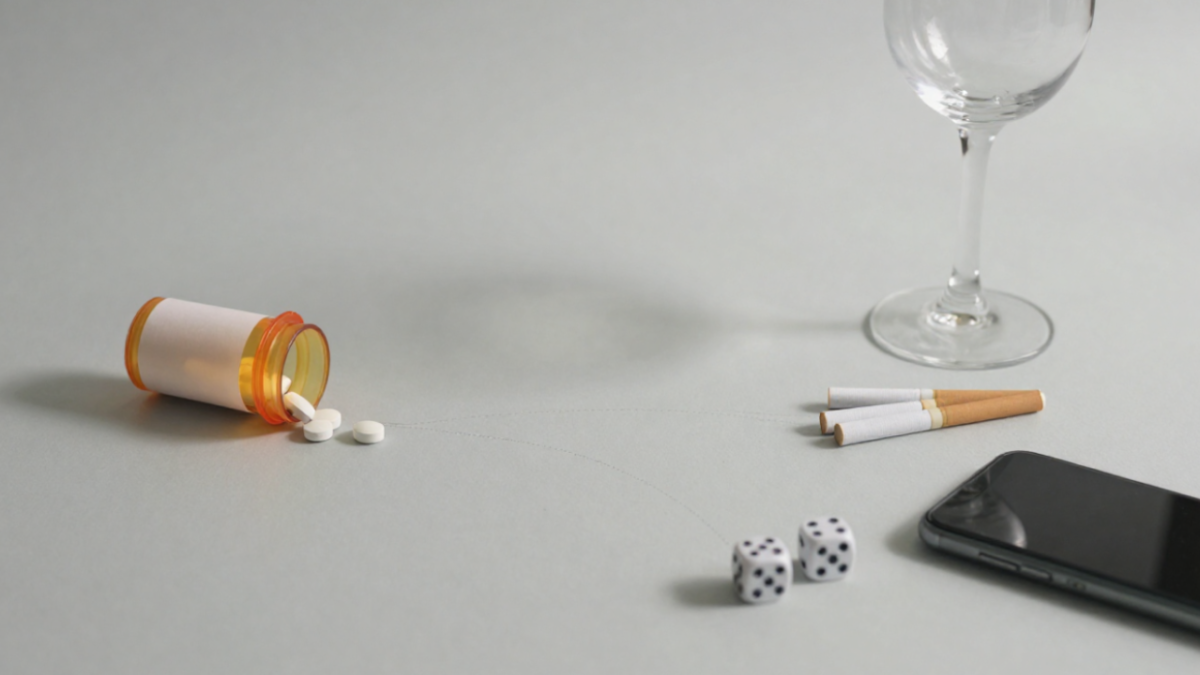
Cross-addiction means trading one habit for another because we remain dysregulated. Healing requires nervous system safety.
Key Summary
Cross addiction (also known as addiction substitution or addiction interaction disorder) occurs when an individual ceases one addictive behaviour only to substitute it with another. Because the brain's underlying reward system remains chemically or neurologically dysregulated, it naturally migrates to alternative dopamine triggers. As a food addiction specialist counsellor, I frequently witness this as a two-way street: individuals often substitute a substance like alcohol with compulsive eating, or conversely, once their relationship with food stabilises, the compulsion migrates toward gambling, work, or digital screens. True recovery requires treating the underlying trauma or nervous system imbalance rather than simply changing the substance or behaviour. Ultimately, recovery from one addiction can bring awareness to other addictive behaviours that have been quietly operating in our lives.
Always Out of Balance with… Something
You’ve finally recovered from food addiction and binge eating. Maybe you’ve even quit drinking and walked away from drugs. What an accomplishment—what freedom! From the outside looking in, your recovery is an absolute triumph. You breathe a sigh of relief and celebrate your newfound stability.
Yet, in the quiet spaces of daily life, a restless, familiar hum continues to vibrate.
You find yourself intensely staring at an online shopping cart filled with items you do not need. You realise you have spent hours completely lost in social media, chasing micro-doses of validation. Or perhaps you are suddenly noticing how your whole life has been entirely filled by over-working, or giving too much to everyone but yourself.
Sometimes it all seems like a bit of a game. Clinically, it is called cross addiction, and without intentional awareness, recovery can easily morph into nothing more than "rearranging the deck chairs on the Titanic."
What Does Cross Addiction Look Like in Daily Life?
Often, we measure recovery solely by the single substance or behaviour we managed to stop, because that process of stopping has taken us months, years, or sometimes even decades to accomplish. Frequently, it’s only then that we notice the systemic nature of our compulsion.
To evaluate whether a cross addiction has developed, it makes sense to look at your behaviours holistically. Consider these critical, framing questions:
Your food may be perfectly fine, but how is your money? Are you trading the immediate chemical high of a substance for the thrill of compulsive overspending, chronic debting, chronic underearning, or high-risk financial trading?
Your sobriety date is intact, but how is your work? Are you noticing that your career has always been the socially acceptable hiding place to escape emotional presence, family responsibilities, or internal stillness? Are you hopelessly overscheduled? Or, have you fallen into work avoidance, lingering in the world of invisibility and smallness?
You are no longer using substances, but how is your phone? Are you tethered to notifications, dating applications, or video games simply to keep your mind from sitting with itself?
The catastrophic crises have passed, but how are your relationships? With the food and drink under control, are you noticing compulsive, default patterns in your relationships that move you either too quickly into intimacy, or trap you in "love avoidance"?
Why Do People Swap Addictions?
The physiological answer lies within the brain's reward architecture. Chronic exposure to addictive substances or compulsive behaviours down-regulates dopamine receptors, meaning the brain requires a high baseline of stimulation just to feel normal or safe.
When you eliminate the primary substance or behaviour without addressing the underlying emotional and neurological landscape—and without learning appropriate new strategies for living—an intolerable internal void forms.
The brain's survival mechanisms are highly efficient; they do not discriminate based on the source of the chemical cascade. Whether a dopamine surge is triggered by a chemical substance, an Amazon checkout page, a casino floor, or a social media alert, the brain simply recognises the excitement of pursuit and a momentary relief from dysregulation.
Which Addiction Should You Treat First?
When navigating overlapping addictions (such as chemical dependency alongside an eating disorder or gambling), establishing a clinical hierarchy is notoriously difficult. Leading trauma and recovery experts approach this problem through distinct, highly respected frameworks.
1. Dr. Patrick Carnes – The Addiction Interaction Model
Dr. Patrick Carnes, a pioneer in behavioural addiction treatment, introduced the concept of Addiction Interaction Disorder (AID). He establishes that multiple addictions rarely exist in isolation; instead, they interact, cross-trigger, and reinforce one another to preserve a singular, overarching system.
The Hierarchy of Treatment: Carnes suggests that trying to treat one addiction while actively ignoring another is a leading cause of relapse. However, on a practical level, his model utilises a consequence and lethality triage system.
The Strategy: You must immediately stabilise whichever addiction poses the most critical threat to life, medical safety, or legal freedom (e.g., severe alcohol withdrawal or acute eating disorder medical crises). Simultaneously, secondary behaviours must be monitored and treated, or they will instantly expand to fill the void left by the primary addiction.
2. Jan Winhall, M.S.W. – The Felt Sense Polyvagal Model
Recently, I completed an introductory training with Jan Winhall, a prominent psychotherapist and author. Winhall reframes addiction entirely through the lens of nervous system regulation and trauma, moving away from the traditional medical "disease model."
Utilising Polyvagal Theory, Winhall views addictive behaviours as intelligent, adaptive, "bottom-up" coping strategies meant to regulate a chronically overwhelmed nervous system.
The Nervous System Split: A person may use one behaviour to escape a frozen, depressed, "dorsal vagal" state (Hypoarousal) and another to numb out the anxious, racing mind of "sympathetic activation" (Hyperarousal).
The IFS Connection: This framework aligns beautifully with Internal Family Systems (IFS) therapy, which holds that these addictive behaviours are carried out by protective parts of us ("managers" or "firefighters") to ensure our safety and ultimate survival.
Winhall’s strategy targets the nervous system first. By shifting focus away from sheer behavioural compliance and toward tracking the somatic "felt sense," individuals learn to safely anchor their bodies. When the nervous system stops living in a state of perpetual threat, the desperate urge to utilise addictive behaviours naturally de-escalates.
Cross Addiction vs. Multiple Addictions: What’s the Difference?
A common question that arises is: Is cross addiction exactly the same as having multiple addictions, or can we just refer to it broadly as "addiction"?
The Canadian Centre for Addictions suggests that cross addiction occurs when a person develops new addictions during or after recovery from another, or struggles with several addictions at the very same time (for example, balancing binge eating with binge-watching television). They actively reinforce and feed each other. Conversely, having several addictions that are entirely independent of one another is slightly different, as they don't necessarily cross-trigger or intertwine.
In my clinical work with clients, however, I use the terms “cross addictions” and “having multiple addictions” interchangeably for two vital reasons:
The Innate Pattern: For the majority of people I work with (who come to me for food addiction), they report always having had this struggle; it feels entirely innate to them. Upon exploring their life history, we almost always find other addictive behaviours that have equally "always been around" or simply morphed from one version into another. In these cases, there is very little clinical utility in spending time differentiating whether we are dealing with a cross addiction or several independent addictions.
The Unity of the Solution: When we focus on the actual solution—how to truly recover—the treatment path looks remarkably similar. We need to implement concrete behavioural strategies specific to each addiction, while intentionally addressing the exact situations in which they interact (such as decoupling the act of eating from watching TV). For example, we might use structured food plans for food addiction, while creating "sober dating plans" for relationship-related obsessions, or "social media use plans" for technology habits.
Importantly, underneath all of those behavioural plans, the root work remains identical: we must address the underlying cause of the addictive behaviours through emotional healing and deep nervous system regulation. Internal Family Systems therapy is a wonderful therapy for that.
Moving Beyond the "Whack-a-Mole" Recovery Model
Sustainable recovery is not about becoming a permanent prison guard to your own impulses, constantly watching yourself to ensure you do not cross an invisible line. Instead, it requires pivoting from punitive self-monitoring to compassionate curiosity.
If you discover that your primary sobriety is intact but your financial health, work-life balance, or digital consumption is in chaotic disarray, do not view it as a personal moral failure. Treat it as an essential, non-judgmental piece of diagnostic data. It is your nervous system signaling that it doesn’t feel safe in the world, and that there may be an unhealed layer of trauma, anxiety, or emotional pain asking for your attention, gentleness, and therapeutic care.
Lived Experience: A Lifelong Journey of Discovery
In my own lived experience, this sense of unsafety and those unhealed layers are incredibly subtle and often hard to spot in the chaos of daily life. For me, they don't always look like an acute crisis; they are more a part of my baseline being—a low-grade hum of restlessness. That’s why recovery feels so much like peeling the layers of an onion, where deeper, older layers continuously become available to heal.
Because of what I see clinically, and because of my own walk through it, I tend to use the singular term “addiction” to describe what I experience as an underlying “wiring”—a combination of neurodivergence, genetic disposition, and a chronically dysregulated nervous system. How that addiction manifests is simply through different outlets. One or another may be “up” at any given time on my journey.
I’ve noticed in my own life that I often experience two sides of the exact same addiction coin, manifesting as either "over-doing" or "under-doing" something. The concept of balance has always been a hard-earned factor in my life, and an addictive loop can resurface at any point. Once again, it points to addiction recovery as a comprehensive lifestyle, not a task to check off and complete. But it doesn’t have to be doom and gloom. It can be a deeply meaningful, beautiful, and rewarding life as we learn to discover new aspects of ourselves and rebalance and grow in the process.
Categories: : Addiction, Food Addiction, Internal Family Systems, Recovery

Acknowledgement of Country
I recognise the history, culture, diversity and value of all Aboriginal and Torres Strait Islanders, and acknowledge their Elders past and present.
I acknowledge that sovereignty has never been ceded, and support reconciliation, justice and the recognition of the ongoing living culture of all First Nations people by providing welcoming and culturally informed services.
Embracing inclusivity and diversity, I also support a culture of inclusion, respect, choice, voice and diversity and am committed to supporting all people to be mentally well and engaged in their communities.